
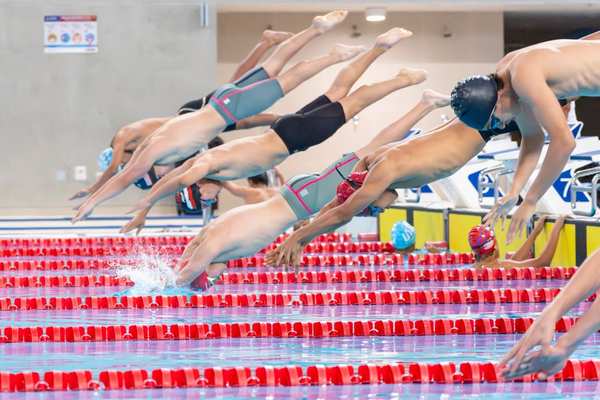
A swimming relay can swing on a fraction of a second, but the fastest exchange is useless if the outgoing swimmer leaves too early. Swim relay rules govern more than speed: they establish stroke order, starting positions, handovers, lane conduct and disqualifications. Knowing what officials judge helps swimmers race aggressively without putting the team at risk.
How a Swimming Relay Works
A standard competitive pool relay has four swimmers, each completing one-quarter of the event distance. In a 4 × 100-metre race, each person swims 100 metres; in a 4 × 200-metre race, each swims 200 metres. One teammate finishes at the wall, and the next starts their leg. A swimmer cannot take two legs in the same relay.
Two familiar formats are the freestyle relay and the medley relay. The first allows each swimmer to use any stroke, although front crawl is normally fastest. The second assigns a different stroke to each leg. Mixed relays under World Aquatics rules include two men and two women, with the team choosing positions subject to the event’s stroke sequence.
Freestyle Relay Versus Medley Relay Order
The Fixed Medley Sequence
The medley relay always follows backstroke, breaststroke, butterfly, then freestyle. This differs from the individual medley, which begins with butterfly. In the final medley leg, freestyle means a stroke other than backstroke, breaststroke or butterfly; swimmers almost always use front crawl.
Each medley swimmer must observe the technical rules of their assigned stroke. Breaststroke and butterfly require a simultaneous two-hand touch at the finish of the leg. The backstroke swimmer must finish on the back. A legal relay exchange cannot rescue an illegal stroke finish.
Choosing the Swimmers’ Order
For a freestyle relay, coaches can place swimmers strategically: a dependable starter may lead off, while a strong racer under pressure may anchor. Medley order is fixed by stroke, not preference. Teams must submit names and swimming order by the meet’s deadline and follow that declaration. Substitution rules depend on the governing body and competition.
At World Aquatics events, a change after the deadline generally requires an evidenced medical emergency and permission from the appropriate official, while an eligible team’s composition can change between heats and finals. Swimmers should check entry procedures rather than assume they can switch places behind the blocks.
Relay Starts and Exchanges Explained
Who Starts From the Water?
The first swimmer in a freestyle relay uses a conventional forward start following the starter’s signal. The first medley swimmer starts in the water because the opening leg is backstroke. The remaining swimmers normally take over from the starting platform. Under World Aquatics pool rules, relay exchanges must begin from that platform; a running start from the deck is prohibited.
Some local, adaptive or age-group competitions have provisions for approved in-water starts. Confirm those arrangements in the meet rules rather than treating them as the default.
The Exact Moment a Relay Takeover Becomes Legal
Here is the central relay exchange rule: the outgoing swimmer’s feet must remain in contact with the starting platform until the incoming teammate touches the finishing wall. The outgoing swimmer may bend, swing their arms and prepare to launch, but neither foot may lose contact too soon. The comparison is the incoming touch against the outgoing loss of foot contact, not the moment the second swimmer enters the water.
Consider a 4 × 100-metre freestyle relay. Swimmer two sees swimmer one approaching and begins an arm swing. If swimmer two’s feet leave the block before swimmer one touches, the team risks disqualification even if the dive looks well timed. If the feet remain in contact until the touch, an immediate launch can be legal.
Practise exchanges with a coach observing both the approaching hand and departing feet. Build consistency before chasing tiny gains. A slightly conservative takeover with a clean finish serves the team better than a spectacular but premature jump.
Lane Procedures and Common Relay Disqualifications
Teams must respect their assigned lane and avoid interfering with other competitors. After completing a leg, a swimmer should leave the water promptly and safely without obstructing swimmers still racing. Teammates who are not due to swim must not jump into the racing pool before the event finishes.
Common causes of relay disqualification include an early takeover, swimming in an order different from the declared lineup, an incorrect medley stroke or stroke finish, interference, and an unauthorized team member entering the water. Ordinary stroke rules still apply within each leg, including legal turns, touches and underwater distance limits where relevant.
For example, a butterfly swimmer in a medley relay who finishes with only one hand can disqualify the team even if the next swimmer waits for the wall touch. Likewise, a breaststroke swimmer must meet the applicable stroke and kick requirements throughout their leg. Relay exchanges are only one part of a legal swim.
How Officials Check a Relay Exchange
Takeovers may be assessed by officials watching the wall and platform, by electronic equipment, or by a combination specified in meet procedures. A displayed takeover number should not be treated as automatic proof of legality without the event’s officiating process. The referee applies the relevant competition rules when deciding a reported infraction.
Teams should not rely on an assumed electronic timing allowance. Learn the competition’s regulations, listen to officials and practise a repeatable exchange. The legal requirement depends on actual wall contact.
Race-Day Checklist for Relay Teams
Before reporting to the blocks, confirm the submitted lineup, each swimmer’s leg, the lane assignment and whether the event is freestyle or medley. Have the lead-off swimmer follow starting commands, and make sure subsequent swimmers understand the feet-on-platform exchange rule. Agree on a practice approach for the final metres rather than improvising during competition.
For new competitors, a swimming meet guide can clarify reporting and marshalling arrangements. Stroke-specific refreshers on backstroke starts and swimming turns are useful preparation for medley relays, too.
Frequently Asked Questions
Can you jump before your teammate touches the wall?
No. In a standard block takeover, your feet must not lose contact with the starting platform before your teammate touches the wall. You can begin preparatory movement earlier, but leaving early is a relay violation.
What is the order of strokes in a medley relay?
Backstroke first, breaststroke second, butterfly third and freestyle fourth. The backstroke swimmer starts in the water, while the next three typically start from the platform.
Can one swimmer race twice in the same relay?
No. Each of the four swimmers completes one leg. A relay lineup cannot assign two legs to the same athlete.
Can the relay lineup change between heats and finals?
It can under World Aquatics rules when replacement swimmers are eligible, but the lineup must still be properly declared. Meet-specific entry rules and deadlines also matter.
Conclusion
Successful relays combine good swimming with precise teamwork. Learn the stroke order, submit the correct lineup, protect every wall touch and train exchanges that are reliably legal. Those habits let a team focus on racing rather than wondering whether its finish will stand.