
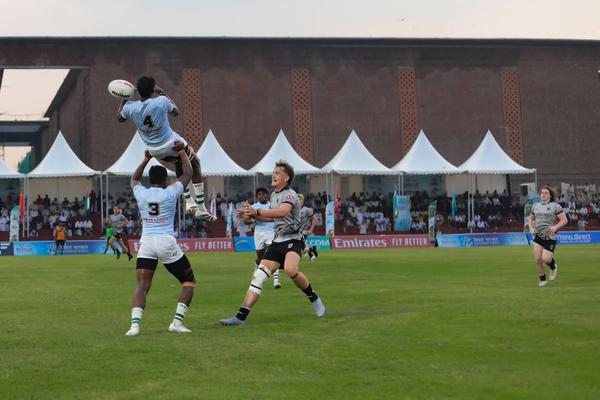
One sprint, one missed tackle or one kick can change an Olympic medal race in seconds. That is the appeal of rugby sevens, especially for American viewers discovering the sport through the Olympics. But the action makes more sense once you understand how teams move from the opening pools to the medal matches.
The Olympic rugby sevens format used at Paris 2024 featured separate men’s and women’s competitions, each with 12 national teams. The route was straightforward: three pool games per team, an eight-team quarterfinal bracket, semifinals and matches for gold and bronze. The wrinkle is that finishing third in a pool does not necessarily mean elimination.
How the Olympic Rugby Sevens Tournament Is Organized
Each 12-team competition begins with three pools of four, labeled A, B and C. Every team plays the other three teams in its pool once. That produces six matches per pool and 18 pool matches per tournament.
After Olympic pool play, eight teams reach the quarterfinals: the top two from each pool, plus the two strongest third-place finishers. The remaining four teams enter placement matches rather than the medal bracket. The same broad structure applies to the men’s and women’s events, although Olympic organizers publish an event-specific schedule and bracket.
Olympic sevens is not simply a league table where the top eight teams are automatically paired first against eighth, second against seventh and so on. Pool positions feed into predetermined knockout slots.
How Pool Standings and Qualification Work
Match points are different from points scored
In the Paris 2024 system, teams earned three standings points for a win, two for a draw and one for a loss. These points determine pool rankings; they are not the same as the tries, conversions and penalties shown on the scoreboard.
A team winning all three pool games collected nine standings points. A team winning twice and losing once collected seven. Games can end level during the pool phase, so a drawn match still affects the standings. There are no bonus points for scoring four tries or losing narrowly in this Olympic pool system.
Why points difference can decide a quarterfinal place
Teams equal on standings points are separated using tournament tiebreakers. Head-to-head results are relevant when two teams in the same pool are level; points difference and additional measures help resolve other ties and compare third-placed teams from different pools.
Consider a hypothetical team that wins its first game, loses its second and enters the final pool match needing to stay among the two best third-place finishers. A defeat by five points could leave its overall points difference competitive. A defeat by 35 could make qualification much harder, even though both losses earn the same standings points. That is why teams keep attacking and defending until the final whistle.
The practical viewing tip is to check standings points first, then the points-for and points-against columns. A third-place team may still be alive even when a team in another pool has already secured second place.
From the Quarterfinals to the Sevens Medal Rounds
The quarterfinal bracket
At Paris 2024, the three pool winners, three runners-up and two qualifying third-place teams filled eight predetermined quarterfinal places. For example, the Pool A winner was assigned the second-best qualifying third-place team, while other ties paired specified pool winners and runners-up. This fixed pathway prevents organizers from simply re-ranking all eight qualifiers into a conventional seed-versus-seed bracket.
Quarterfinals are knockout matches: win and advance; lose and the gold-medal opportunity ends. Losing quarterfinalists can still contest classification games for fifth through eighth places. Teams outside the top eight play separate placement fixtures for ninth through twelfth.
Semifinals, bronze and gold
The four quarterfinal winners advance to two semifinals. Those winners meet in the gold-medal match, with silver going to the losing finalist. The two semifinal losers play for bronze. A team therefore cannot win bronze by losing a quarterfinal; it must reach the semifinals first.
The United States women demonstrated that a semifinal defeat still leaves a medal within reach in Paris 2024: after losing to New Zealand, they beat Australia 14–12 with a dramatic late try by Alex Sedrick to earn bronze, the country’s first Olympic sevens medal.
What Makes an Olympic Sevens Match So Fast?
Rugby sevens uses seven players per side on a full-sized rugby field. Regulation matches have two seven-minute halves, with a short halftime break. Less congestion creates space for breakaways, but it also makes defensive positioning and fitness essential. The basic contest is familiar to rugby union fans, with important changes in pace and restart mechanics.
A try is worth five points, and a successful conversion adds two. Penalty goals and drop goals are worth three, although tries dominate most sevens scoring. Conversions in sevens are taken as drop kicks, helping games restart quickly. Scrums feature three players from each team rather than the eight used in the 15-a-side code.
Matches tied after regulation in the knockout phase go to sudden-death extra time, played in five-minute periods. The first team to score in extra time wins. Pool matches, by contrast, can finish as draws. A yellow card generally means a two-minute suspension, a significant disadvantage in a match lasting just 14 regulation minutes.
For newcomers, a useful companion topic is rugby sevens rules, particularly what happens after a try, a turnover or an infringement. Another is rugby sevens positions: players cover enormous distances and frequently switch attacking and defensive responsibilities.
Why the Format Rewards More Than Just Speed
Short games invite spectacular plays, but tournament management matters just as much. Teams must recover between matches, protect points difference in pool play and adapt quickly when the bracket becomes clear. An unbeaten pool run secures progression, yet it guarantees neither a medal nor an easy quarterfinal.
Readers familiar with rugby union may also find it helpful to compare rugby union versus rugby sevens before watching their first tournament.
Olympic Rugby Sevens Format: Frequently Asked Questions
How many teams compete in Olympic rugby sevens?
At Paris 2024, 12 men’s teams and 12 women’s teams competed in separate tournaments. Each competition was divided into three pools of four.
How many teams advance from pool play?
Eight per tournament: the first- and second-place teams in all three pools, plus the two best third-place teams.
Can a team lose a match and still win Olympic gold?
Yes. A pool-stage loss does not automatically eliminate a team. Once the knockout bracket starts, however, a loss ends its chance of gold.
What happens when a knockout match is tied?
Teams play sudden-death extra time in five-minute periods. The first score settles the match, unlike pool games, which may end in a draw.
The Route to an Olympic Medal, in Brief
To follow Olympic rugby format without getting lost in the bracket, remember the sequence: three pool matches, eight quarterfinalists, four semifinalists and two medal fixtures. Watch the third-place rankings during the pools and the bronze-medal matchup after the semifinals. Those are often where the biggest surprises emerge. In a sport this quick, understanding the route to the podium makes every try feel more consequential.