
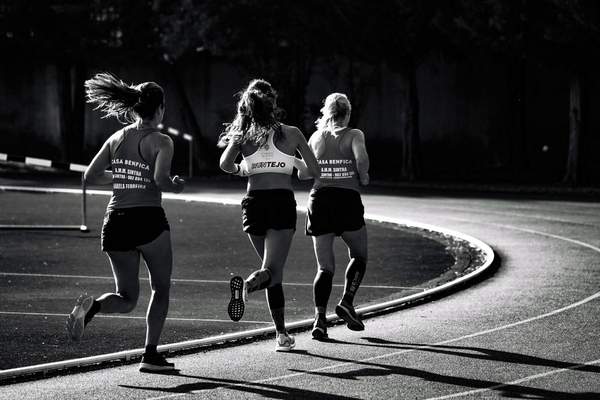
Olympic race walking can look like running in slow motion, but the difference is more than speed. Athletes must obey two technical requirements throughout a demanding endurance race. Judges watch every stride, and a competitor with winning pace can lose their result through illegal technique.
Understanding the ground contact rule, straight leg rule, and race walking penalties reveals what makes this road discipline different from the track races alongside it.
The Two Rules That Define Race Walking
Ground Contact: No Visible Flight Phase
The walker must maintain contact with the ground so that no loss of contact is visible to the human eye. Running has an airborne phase; legal race walking must not display one.
The word “visible” is crucial. High-speed footage can capture a tiny gap between the feet and the road, but judges assess movement with their unaided eyes. A slow-motion replay showing a split-second airborne phase does not, by itself, prove a judging violation.
Straight Leg: From Landing to Upright
The advancing leg must be straightened, meaning not bent at the knee, from its first contact with the ground until it reaches the vertical upright position beneath the body. That is the straight leg rule.
The knee does not have to stay straight during the entire stride. It may bend after the body passes over the supporting leg and as the leg swings forward again. The critical period begins at touchdown and ends when that supporting leg reaches vertical.
Why Race Walking Technique Looks Unusual
Elite walkers use quick turnover, efficient hip rotation, purposeful arm movement, and precise foot placement. Their rolling movement helps them cover ground rapidly while maintaining a straight supporting leg.
Acceleration creates a dilemma. Reaching too far forward may cause a bent knee on landing, while pushing off too aggressively may produce visible lifting. Successful race walking technique balances speed with legal mechanics, particularly late in a race when fatigue makes control harder.
For context on how this road event differs from stadium disciplines, readers can also explore Olympic track and field events.
How Judges Assess Olympic Race Walkers
Specialist race walking judges observe athletes independently from different points around the course. World Athletics rules generally provide for six to nine judges, including the chief judge, in road races. Their contact and knee judgments rely on direct observation with the human eye.
What Does a Yellow Paddle Mean?
A judge who is not fully satisfied with an athlete’s technique may display a yellow paddle showing either the loss-of-contact or bent-knee symbol. It is a caution that gives the walker a chance to correct their movement.
A yellow paddle is not a red card. Nor must a judge always show yellow before reporting a clearly observed infringement. Confusing cautions with formal red cards is a common reason spectators misunderstand disqualifications.
How Red Cards Work
If a judge sees visible loss of contact or an illegally bent knee, they send a red card to the chief judge’s recording system. It identifies the athlete, judge, offence, and time. Posting boards normally show reported cards so competitors can track their position.
Only reports from different judges count toward the usual three-card threshold. An athlete is not disqualified merely because one judge repeatedly dislikes their style.
Race Walking Penalties and Disqualification
Under the standard system, three red cards from three different judges lead to disqualification. The athlete is notified with a red paddle, although delayed notification does not cancel a valid disqualification.
Some events use a penalty zone instead. In those races, the third red card requires a timed stop before the athlete can continue. Under the 2026 World Athletics rules, the stop lasts two minutes for a half-marathon race walk and four minutes for a marathon race walk. A further red card from another judge results in disqualification.
Not every race operates a penalty zone. The competition regulations determine which procedure applies. If an athlete cannot practically serve a required stop before finishing, the appropriate penalty time can be added to their result.
The chief judge also has a special power during the final 100 metres: an athlete whose technique obviously breaks the rules can be disqualified regardless of their previous red-card count. That safeguard matters when contenders sprint for the line.
What a Last-Kilometre Penalty Might Look Like
Imagine a walker entering the final kilometre with two red cards. They raise their cadence to catch the leader. Another judge sees visible lifting and files a third card. In an event without a penalty zone, that means disqualification. Where the penalty-zone procedure applies, the walker must serve the prescribed stop instead, unless a further independent card or other disqualifying breach follows.
For a practical training check, record a short side-on video of your walking at normal speed. Look at the front knee on landing and the changeover between supporting feet. Footage helps a coach identify possible problems, but official judging is still a human-eye decision.
Olympic Race Walking Distances Have Changed
Older descriptions of the Olympic programme can be misleading. At Paris 2024, men and women competed in separate 20km walks, alongside a marathon-distance mixed relay involving one male and one female walker per team. The historic men’s 50km event had already been removed.
From 2026, World Athletics introduced the half-marathon race walk (21.0975km) and marathon race walk (42.195km) as new standard senior road distances for its World Athletics Series, replacing the previous 20km and 35km championship distances. The Los Angeles 2028 Olympic schedule lists individual men’s and women’s half-marathon race walks.
Distance and event format therefore depend on the particular Games or championship. The fundamental technique rules still distinguish walking from running, whatever the course length. A guide to marathon race strategy offers a useful endurance comparison, while Olympic disqualification rules provide wider competition context.
Frequently Asked Questions
Can race walkers ever have both feet off the ground?
The rule prohibits loss of contact visible to the human eye. A momentary flight phase seen only on slow-motion footage does not automatically establish an infringement under the sport’s judging standard.
Does any bent knee break the rules?
No. The advancing leg must be straight from initial ground contact until vertical. Bending during the recovery phase is permitted. A red card concerns a breach during the required straight-leg portion.
Do three yellow paddles mean disqualification?
No. Yellow paddles are cautions, whereas red cards report confirmed infringements. Three red cards from different judges lead to disqualification under the standard system or a penalty-zone stop when that procedure is in force.
Why do race walkers rotate their hips?
Controlled hip rotation helps extend the stride and sustain speed while respecting the straight-leg and contact requirements. Judges do not award style points for hip movement itself.
The Skill Behind a Legal Finish
Olympic race walking rewards endurance and precision in equal measure. Every surge must preserve visible ground contact and a straight supporting leg. Once you understand how judges, red cards, and event-specific penalties work, a close finish becomes more than a test of speed: it is a test of technique under pressure.